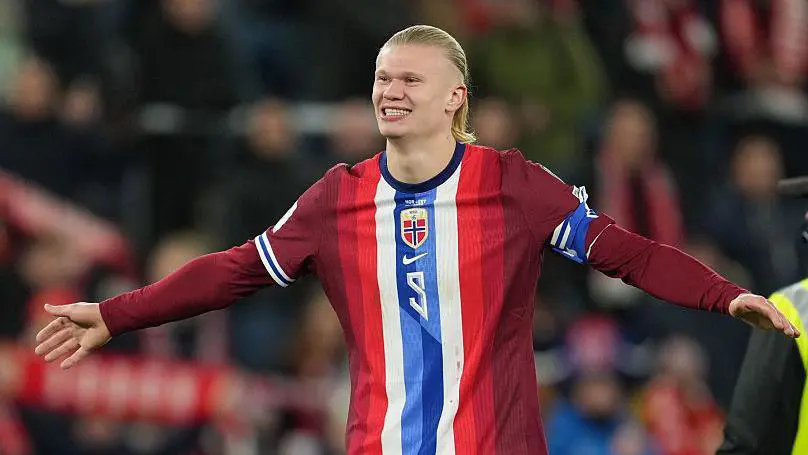
Erling Haaland Leads Norway to World Cup Qualification
Generational talent Erling Haaland is set to make his debut at a major international tournament next summer, having successfully led Norway to the World Cup.
The 25-year-old Manchester City striker achieved this remarkable feat by scoring 16 goals in just eight World Cup qualifying matches, finding the net in every game.
This impressive performance positions him as the top scorer in the 2026 World Cup qualifying rounds across all continents.
Norway's emphatic 4-1 victory over Italy on Sunday, in which Haaland netted twice, secures their place in the upcoming World Cup in North America.
This will mark Norway's fourth World Cup appearance and their first major tournament since Euro 2000.
“We’ve not had someone who’s been an outright superstar in the way that Erling is,” remarked Norwegian journalist Lars Sivertsen. “I think there’s already a case to be made that he’s our greatest ever player.”
Haaland's Impact on Norwegian Football
Haaland's goal-scoring record for Norway is nothing short of extraordinary. He has amassed 55 goals in 48 international matches, becoming only the sixth player—and the first in 53 years—to score 50 goals in fewer than 50 caps.
Norway's previous top scorer, Jorgen Juve, held the record with 33 goals for 90 years.
During the qualifiers, Haaland not only scored 16 goals but also provided two assists, which is double the tally of any other player in Europe.
He has maintained his scoring streak, having not gone a match without a goal for over a year, and has netted 32 goals in 20 games this season across all competitions.
However, Haaland's success is not solely attributed to his individual brilliance. Captain Martin Ødegaard, 26, leads European qualifying with seven assists and has made 67 appearances for Norway since debuting at 15.
“Combining Haaland’s success with the fact that we also have Martin Ødegaard in this generation is remarkable,” Sivertsen noted. “We’re a country of five million, and we have both the best striker and arguably one of the best playmakers in the Premier League. This is something I cherish.”
Sivertsen emphasized that while Haaland is pivotal, the team’s overall strength is crucial for success. He likened their situation to that of Wales during their Euro 2016 semi-final run, highlighting the importance of a supportive team structure.
Norway's Long-Awaited Return
For the first time in a generation, Norwegian fans will experience the excitement of supporting their national team at an international tournament.
Norway has previously participated in the World Cups of 1938, 1994, and 1998, as well as Euro 2000. Haaland's father, Alf Inge, played in the 1994 World Cup, and Erling has expressed a strong desire to surpass his father's achievements.
While Alf Inge did not win any trophies during his club career, Erling has already clinched a treble with Manchester City, along with additional titles in Austria and Germany.
“Norway will never win the World Cup,” Haaland Jr. told Time Magazine in July. “If we qualify, it would feel like another big nation winning it. It would be the biggest party ever, with incredible scenes in Oslo.”
Sivertsen added, “From a country of our size, we have to rely on good generations. There have been lean years, but recently we’ve had strong players in top clubs, yet we still missed out on several tournaments. The relief of finally qualifying is immense.”
Haaland: An Unconventional Norwegian Hero
How is Haaland perceived in Norway? “In some ways, Erling is not a typical Norwegian,” Sivertsen explained. “He’s confident and a bit brash, fully aware of his value and quality.”
This contrasts with the traditional Scandinavian culture of humility, exemplified by figures like Ole Gunnar Solskjær, who was known for his uncomplaining demeanor as a squad player.
“Erling would not be content on the bench, which makes him an intriguing hero for us,” Sivertsen remarked. “There’s a profound sense of pride in having such a player represent our country.”
Averting an Unfortunate Legacy
Haaland's qualification for the World Cup ensures he will not join the ranks of great players who never participated in the tournament.
Three Ballon d'Or winners—George Weah, George Best, and Alfredo Di Stefano—never featured in a World Cup, alongside other legends like Gunnar Nordahl, who was unable to compete due to Sweden's restrictions on professional players at the time.
Haaland's achievement not only elevates his status but also marks a significant moment in Norwegian football history.
Topics
Related news
- Wales Prepares for World Cup Qualifier Against Kazakhstan
- Wales' World Cup Hopes After Victory in Kazakhstan
- Messi Shines in Emotional Farewell Match in Argentina
- Haaland Shines as Norway Dominates Moldova in World Cup Qualifier
- Norway Nears First World Cup Appearance in 28 Years
- Norway Secures World Cup Spot with Haaland's Heroics
