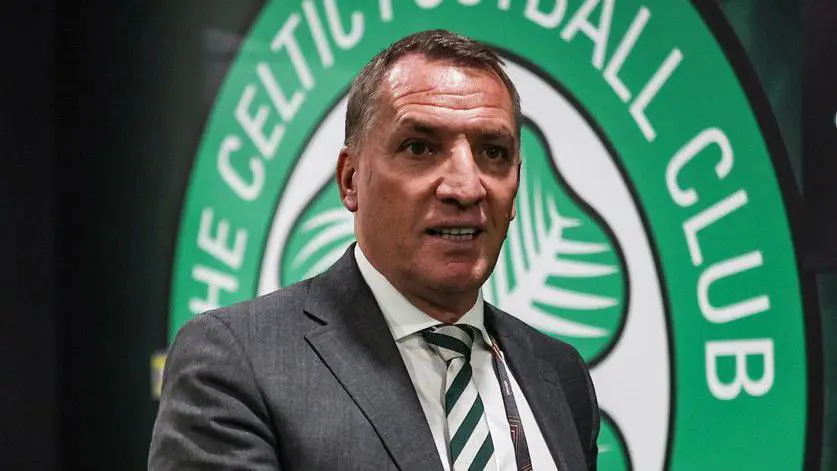
Celtic Football Club: Brendan Rodgers Resignation and Fallout
Brendan Rodgers Resigns from Celtic Amid Controversy
At first, the farewell - and then the filleting.
On Monday night, Celtic Park issued two notable statements: one from the club confirming Brendan Rodgers' resignation, and another from major shareholder Dermot Desmond, who harshly criticized the former manager.
As always, there are two sides to every story, and now we await Rodgers' response. In the meantime, it is essential to closely examine the words released by Celtic and their implications.
"Celtic Football Club can confirm that football manager Brendan Rodgers has today tendered his resignation."
While many anticipated that Brendan Rodgers would not return to Celtic next season, few expected him to resign at this juncture. Just days prior, he expressed his motivation, stating, "I was never more motivated in my time at Celtic." Following a 3-1 defeat to Hearts, he remarked, "I’ve never worked harder in all my time here. The motivation is there to try and flip the levels that we’re at. It’s absolutely fine; it’s still so early. We just have to hang in there, find those performances, and hopefully improve as the season progresses." Yet, just over 24 hours later, he was gone. This raises significant questions about what changed so suddenly.
Desmond's statement revealed, "In June, both Michael Nicholson and I expressed to Brendan that we were keen to offer him a contract extension to reaffirm the club’s full backing and long-term commitment to him. He said he would need to think about it and revert. Yet in subsequent press conferences, Brendan implied that the club had made no commitment to offer him a contract. That was simply untrue." This situation remains open to interpretation, with only those present knowing the exact discussions that took place.
In August, Rodgers indicated he was happy at the club, stating, "when the club feels there’s that time to make an offer, then they will do so." However, in September, he mentioned that he had not received an offer to consider, asserting, "I am not going to be so arrogant to say I want to be here for another three years. The club might not want me here. I have to respect that. Until there’s something serious on paper, I will continue to do my job." Desmond questioned Rodgers’ public statements about the club's desire for him to stay, yet he did not clarify whether an official offer was ever made.
"Every player signed and every player sold during his tenure was done so with Brendan's full knowledge, approval, and endorsement. Any insinuation otherwise is absolutely false."
This statement refers to the summer signings of striker Shin Yamada and defender Hayato Inamura, which Rodgers termed "club signings." While he did not explicitly state that these players were not sanctioned by him, his comments led many to interpret this as a lack of approval on his part. This perception contributed to a growing distrust between him and the board.
Last month, the Celtic Fan Collective met with key club officials to inquire whether Rodgers had the final say on player signings. Chief Executive Michael Nicholson confirmed that he did. When pressed on why Rodgers referred to "club signings," Nicholson offered no explanation, highlighting the ongoing discord within the club.
Following this, Celtic released a statement addressing the media's portrayal of their transfer dealings, stating, "...much of what is written in the media or online about our transfer dealings is inaccurate. We understand that this leads to frustration among supporters." This raises the question of whether Desmond held Rodgers partly responsible for the misinformation and subsequent fan dissatisfaction.
"His (Rodgers’) later public statements about transfers and club operations came entirely out of the blue."
This assertion seems unfounded, as Rodgers had been vocal about transfers and club operations long before this summer. It was a recurring theme under previous managers as well.
"Regrettably, his words and actions since then have been divisive, misleading, and self-serving. They have contributed to a toxic atmosphere around the club and fueled hostility towards members of the executive team and the Board."
This accusation is severe, and while a toxic atmosphere has indeed emerged at Celtic, Desmond's failure to acknowledge the board's role in this situation is notable. If Rodgers contributed to the discord, the club's poor recruitment and inability to replace key players also played a significant part. Many fan groups feel unheard and believe the club is regressing, leading to increased unrest.
"What has failed recently was not due to our structure or model, but one individual's desire for self-preservation at the expense of others."
Desmond's statement shows a lack of accountability for recent failures at the club. While Celtic's operational model has historically been successful, it has faltered recently, with subpar player recruitment becoming evident. The club has spent considerable money, but questions remain about whether it was spent wisely.
Players like Kyogo Furuhashi, Matt O’Riley, Liel Abada, and Nicolas Kuhn once showcased exceptional talent, yet the current squad lacks that level of quality. The club must address these issues moving forward.
Topics
Related news
- Celtic Manager Brendan Rodgers Addresses Transfer Situation Ahead of Deadline
- Celtic Faces Challenging Champions League Trip to Kazakhstan
- Celtic Manager Brendan Rodgers Expresses Hope for Squad Additions
- Rodgers Focuses on Current Squad Ahead of Champions League Play-offs
- Jamie Vardy's Potential Reunion with Celtic
- Brendan Rodgers Addresses Board Relationship and Injury Concerns
