Historic World Cup Draw: Top Seeds Paired for Semi-Finals
The top four seeded nations will not face each other until the semi-finals of next year's World Cup, marking a historic first for the tournament.
FIFA has announced that Spain (1st seed) and Argentina (2nd seed) will be 'paired' and placed in groups located in opposite halves of the draw.
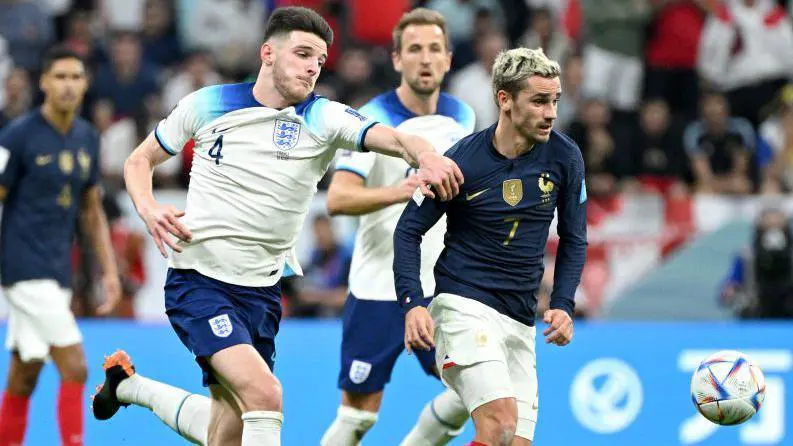
Similarly, France (3rd seed) and England (4th seed) will also be paired, ensuring that England cannot meet Spain or Argentina until the semi-finals, and France until the final, provided all four teams win their respective groups.
When teams are paired, they are placed in opposite halves of the knockout bracket, preventing them from meeting until the final. This format is similar to practices seen at Wimbledon and in the new Champions League structure, where top seeds are kept apart.
FIFA aims to prevent early clashes between top-ranked nations, potentially setting the stage for exciting matchups later in the tournament. This ranking system was previously utilized during the Club World Cup in the summer.
In the previous World Cup, France eliminated England with a 2-1 victory in the quarter-finals, while Spain triumphed over the Three Lions in the Euro 2024 final.
The final draw's four pots have been confirmed and will take place on Friday, December 5, at 17:00 GMT. Scotland will be placed in pot three, while six playoff paths—including teams from Wales, Northern Ireland, the Republic of Ireland, and Italy—will be in pot four.
Newcomers Uzbekistan will also be in pot three, alongside fellow debutants Jordan, Cape Verde, and Curacao in pot four.
How Will the Draw Work?
The World Cup will feature 12 groups, each containing one team from each of the four pots.
FIFA will commence the draw with the teams from pot one. Co-hosts Mexico (A1), Canada (B1), and the United States (D1) will use colored balls featuring their flags to indicate their special status, with predetermined group positions to ensure they play all their matches in their respective countries.
Once drawn, teams will be placed in the first available group in alphabetical order. The draw computer will ensure that Spain, Argentina, France, and England are allocated to the correct sections of the bracket.
The process will continue with pots two, three, and finally pot four. In a departure from previous procedures aimed at expediting the draw, teams will not be assigned specific group positions.
Seeded countries will occupy position one, while a pre-determined random grid will dictate how the other teams are distributed into groups to create the match fixtures.
No group can include more than one team from the same confederation. For example, if Colombia is drawn from pot two, they cannot be placed in a group with Argentina or Brazil.
This rule applies across all pots, with the exception that four groups will feature two European nations, given the 16 European qualifiers drawn into 12 groups.
The inter-confederation playoffs will have limited options for group placements. Pathway 1 (New Caledonia, Jamaica, DR Congo) cannot be grouped with Concacaf or African teams, while Pathway 2 (Bolivia, Suriname, Iraq) must avoid South America, Concacaf, and Asia.
While the date and order of matches will be established during the draw, the specific venues and kickoff times will be confirmed on Saturday, December 6.
Topics
Related news
- Mason Greenwood Approaches Return to International Football with Jamaica
- Trump Displays Chelsea's Club World Cup Trophy in Oval Office
- Kazakhstan vs. Wales: World Cup Qualifier Preview
- Scotland Fans Travel to Zalaegerszeg for Belarus World Cup Qualifier
- Ronaldo Cleared to Play in World Cup Opener After Red Card Suspension
- Infantino Defends World Cup Ticket Prices Amidst Criticism
