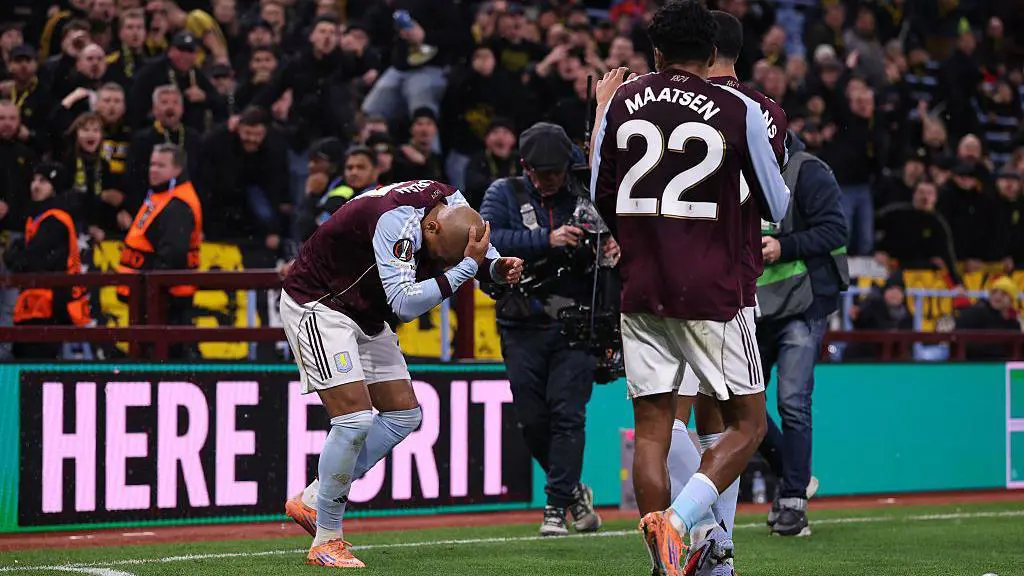
Violence Erupts as Young Boys Fans Clash with Police at Villa Park
Donyell Malen scored to give Aston Villa a lead against Young Boys, but his celebration was marred by violence.
After scoring, Malen ran to the corner flag, where he was met with a barrage of cups thrown by visiting supporters, resulting in a cut on his head.
Following his second goal in Villa's 2-1 Europa League victory on Thursday night, more objects were hurled, and Young Boys fans engaged in violent clashes with police, leading to the arrest of two away supporters on charges of affray and assaulting an officer.
This incident raises questions about whether it is an isolated occurrence or indicative of a larger trend.
While Uefa does not publish historical data, there are currently 116 active stadium bans across all competitions, including women's and youth teams. An additional 16 have been triggered and are awaiting enforcement.
The most frequent offenses include the lighting of fireworks (67 cases), racist or discriminatory behavior (31), throwing objects (25), crowd disturbances (12), and stadium damage (7). These violations could lead to penalties such as banning away fans, partial stadium closures, or playing matches behind closed doors. Typically, bans are suspended for two years and can be activated if the offense is repeated.
Young Boys Fans Recently Lifted from Probation
Young Boys has a history of disciplinary issues with Uefa. Just last week, the threat of a ban on traveling fans was lifted following the expiration of a two-year probation period.
The incident occurred during their previous match in England against Manchester City in November 2023, where they faced similar issues. The Swiss club received a one-match suspended punishment for crowd disturbances, along with fines for throwing objects and causing damage to the stadium.
In February, Young Boys faced a suspended partial closure of their home stadium due to fireworks being lit, which placed them under a new two-year probation.
Uefa is expected to charge Young Boys for the events that transpired on Thursday, but it remains uncertain whether they will impose a strict ban or initiate another probation period for these offenses. They will likely be given 30 days to cover the repairs needed at Villa Park.
Rising Incidents of Fan Disorder
Since the return of football post-Covid, there has been a growing concern over declining standards of supporter behavior. In 2023, arrests at football matches in England and Wales reached a nine-year high, with a 14% increase noted in the 2023-24 season. Data released earlier this year indicated an additional 18% rise in disorder during the 2024-25 season.
However, English clubs have not been implicated in incidents reported to Uefa's disciplinary body; none of the 132 cases involve a Premier League club, despite fans still grappling with a tarnished reputation.
In Uefa's fair play rankings for supporter behavior in the 2024-25 season, England ranked sixth, having played 241 matches. The only countries ranking higher had very small supporter bases, such as the Faroe Islands and Moldova. Germany, ranked 18th, and Spain, ranked 21st, were the closest countries with larger match counts.
Misclassification of risk contributed to the French police's treatment of Liverpool fans prior to the 2023 Champions League final in Paris. Newcastle United also reported that their supporters were “indiscriminately assaulted” by police following their match against Marseille at Stade Velodrome.
Nonetheless, English fans have caused disturbances as well. During the 2023 Conference League final, Fiorentina captain Cristiano Biraghi suffered a head injury from a cup thrown by a West Ham supporter. West Ham was subsequently fined €50,000 (£43,000) and faced a one-match ban for their fans, with an additional match suspended, following a two-year probationary period that just ended.
Given Young Boys' history and their last major offense occurring in Manchester, questions arise as to why they were permitted to have an allocation at Villa Park while Maccabi Tel Aviv was not. Switzerland, with its teams participating in 116 fixtures, ranks among the worst-behaved nations in Europe, sitting at 44th out of 50 countries, while Israel ranks 37th.
Maccabi Tel Aviv was banned from attending the Europa League tie this month due to previous violent clashes and hate crime offenses, leading Birmingham Council's Safety Advisory Group to block their away ticket allocation due to the high risk posed by visiting fans.
The situation surrounding the Maccabi match was particularly sensitive, given Villa Park's location in a predominantly Muslim area and the ongoing tensions related to the Israel-Gaza conflict. Protests outside the stadium resulted in 11 arrests.
When asked whether similar considerations were given to Young Boys, Birmingham Council declined to comment on individual cases but noted that the decision to ban Maccabi fans was unanimous, based on police assessments and recommendations from the SAG.
Young Boys' fans managed to avoid disturbances during their probationary period, indicating that such measures can act as a deterrent. However, fines for incidents of racism and discrimination appear insufficient, especially as they account for a significant portion of suspended sentences.
Most of the 16 pending stadium bans are for racist or discriminatory behavior, which includes home matches played behind closed doors for countries such as Croatia, Georgia, and Romania. Recently, Qarabag was fined just €5,000 (£4,379) for racist abuse during an academy match against Chelsea in Azerbaijan.
Atletico Madrid received a €30,000 (£26,275) fine and a suspended one-match ban from ticket sales for away fixtures due to monkey gestures and Nazi salutes during their 4-0 Champions League loss at Arsenal.
Topics
Related news
- Crystal Palace's Europa League Fate Tied to Lyon's Appeal
- Crystal Palace's Europa League Exclusion Sparks Controversy
- Rangers and Other Scottish Teams Learn Potential European Opponents
- Europa League Kicks Off with Unique Wednesday Matches
- Aston Villa Match Halted Due to Violence
- Aston Villa Advances with Malen's Double Against Young Boys
